Weapons, materials & the start of a system
Pulling back the curtain on the weapons of Eldoria — and a small obsession with what they're made of.
First devlog! We're starting with the fun stuff — the blades you'll carry around Greece, and a question that quietly took over the week: what if what a weapon's made of actually mattered?
The first blades
Greece is the first island you'll explore, so that's where the armoury begins. We blocked out a few blades in Blender: the Xiphos (the short, leaf-shaped Greek sword), the Rudis (the wooden practice sword a certain jittery minotaur shoves into your hands early on), and then a pile of Kopis and other curved blades — because once you start, you can't really stop.
Lining up your first proper weapons and watching them sit in the world never gets old. That's the bit where a folder of files quietly turns into a game.
One blade, every material
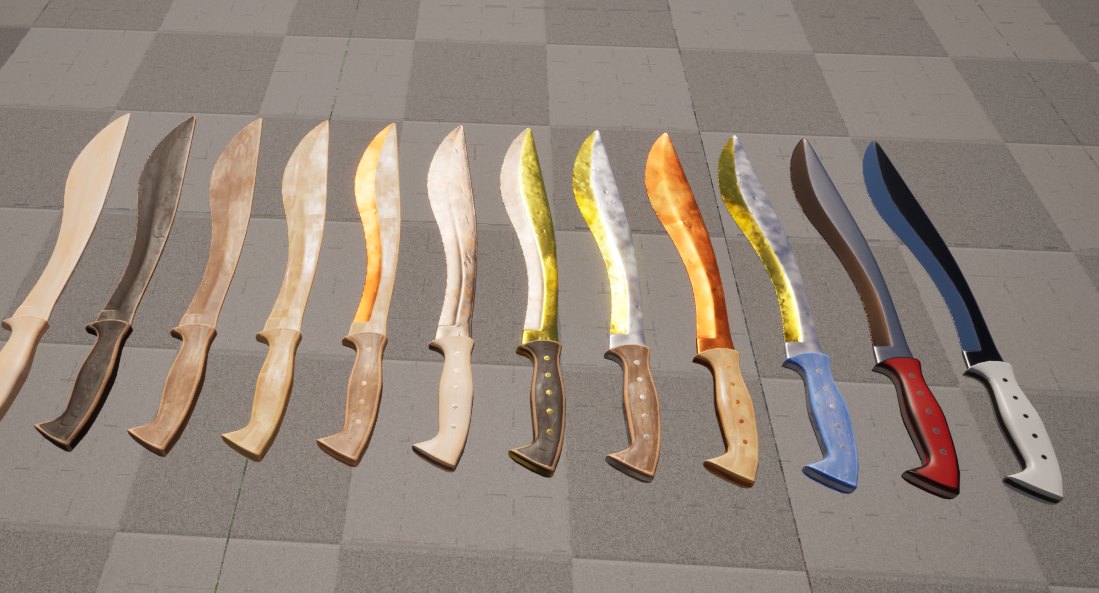
Here's where it got a little out of hand. Instead of finishing one sword, we kept going "ok but what about bronze? what about olive wood?" — and, well, just did all of them:
Woods — cedar, hornbeam, oak, olive wood. Warm, light, the stuff of early and improvised weapons.
Metals — bronze, iron, steel and gold. Heavier, sharper, more dangerous — and more valuable.
And here's the fun part: not one of these is hand-painted. There's no per-sword texturing — they all run off the same handful of baked maps plus a little material trick we'll get to in a second. The point isn't variety for its own sake, though: the idea is that materials carry their own character, with metals leaning into raw power and the precious woods leaning toward the game's stranger, perception-bending side. Lining them all up also shows which ones actually read at a glance, which matters when you're mid-fight and shouldn't have to squint at your own sword.
We've got a favourite. No idea if it's yours — there's a spot at the end to settle it.
How a blade gets its material
This is the bit we're a little smug about — and the reason that line-up isn't a hundred hand-painted swords. Each blade is modelled in Blender, then we bake a few maps off it:
Normal map — bakes the fine surface detail, so the low-poly mesh still catches light like a sculpted one.
Curvature map — finds the edges and crevices, so wear, grime and highlights land where they naturally would.
ID map — the key one. It paints each part of the weapon a flat RGB colour: blade one colour, fuller another, grip another, fittings another.
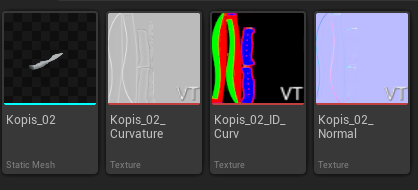
Back in Unreal, that ID map feeds a single layered master material. Each colour is a slot, each slot gets its own material instance — so one mesh + one master material becomes bronze, iron, olive wood, whatever, just by swapping what's plugged into each ID.
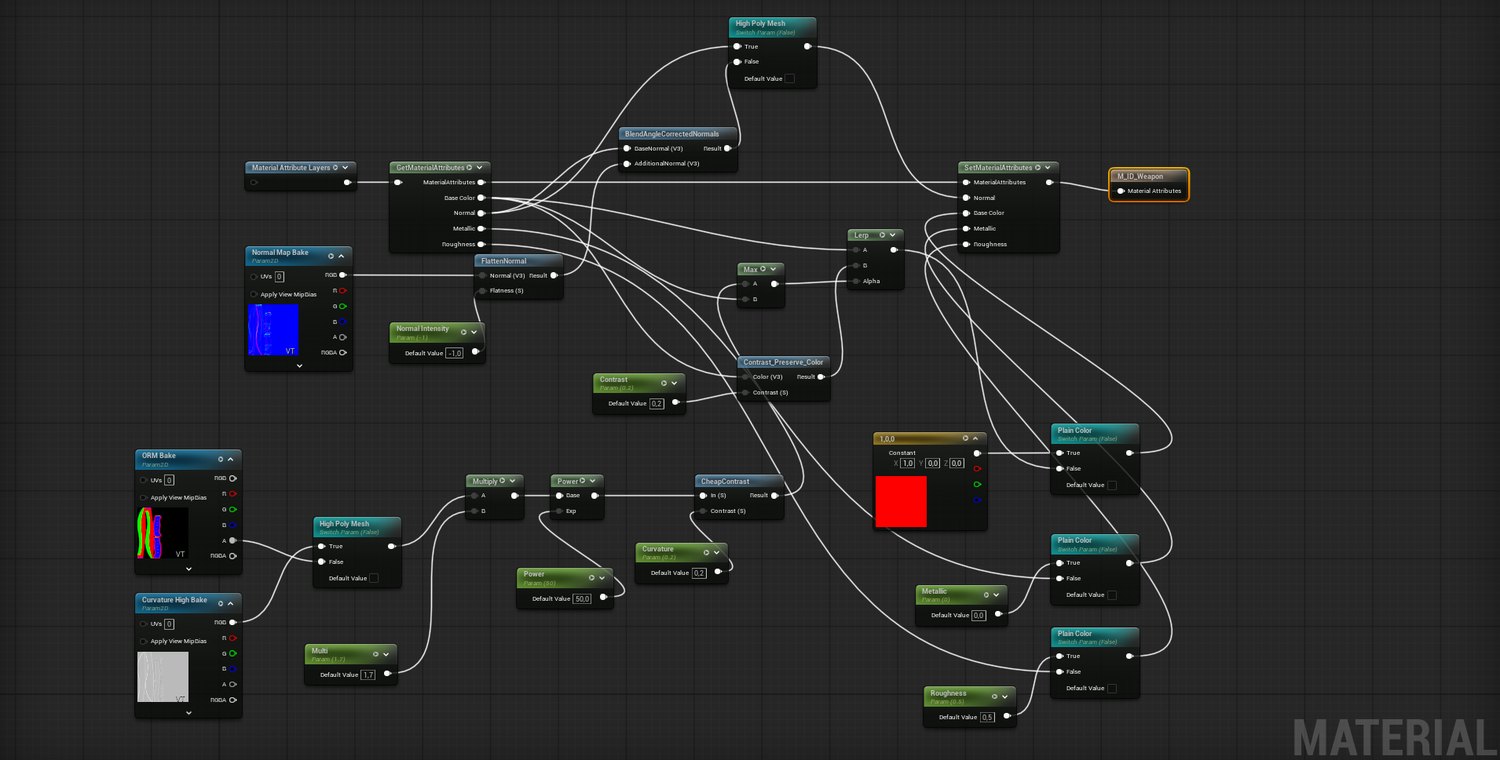
So it's not a stack of unique assets — it's one clever material reading a colour mask. Swap the instances, get a new weapon. Which, conveniently, is exactly what a crafting system wants: grab a material out in the world, slot it in at the Sanctuary, and the blade re-skins itself.
Under the hood
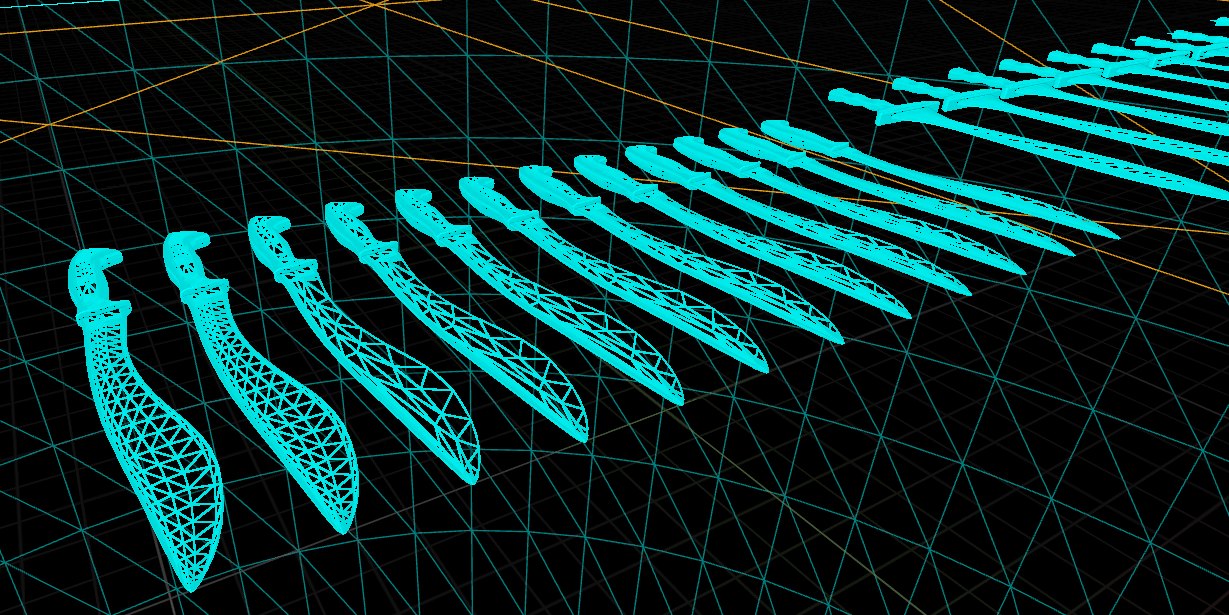
Under all that, the meshes stay light on purpose. The stylised, faceted look isn't us cutting corners — it keeps things fast and lets the silhouette carry the read. The wireframe's just us checking a blade still looks like that blade with the textures off.
Same idea with the systems: we prototype fast in Blueprint to find what's actually fun, and once something proves itself we validate it, optimise it, and move it to C++ — so by the time it reaches you, it's running 100% optimised in Unreal.
What's next
Making a material look different is step one. Next we want it to feel different — hooking materials up to real weapon behaviour, getting blades into your hands, and starting the forge at the Sanctuary where you'll actually craft them. We'll post it here as it happens.
That's a wrap on the first one. Long road to Early Access ahead — glad to have you along.
More devlogs
So… what would you forge?
Swing by the Discord and tell us your favourite blade — and what you'd want to craft. We read everything (and yeah, the good ideas have a way of sneaking into the game).